
How to Choose Sofa Fabric Without Getting Overwhelmed
A shopping cart is easy when someone else has already made the decisions for you. Style A, one of three colors, click.
Custom is different. You choose the body fabric, the welt, the pillows, the cushion fill, the configuration. That's the point of it — and it's also the reason some people get stuck and end up buying something ordinary from somewhere easy.
After twenty-one years of walking people through this, we've learned the problem isn't the number of fabrics. It's the order people go in.
Here's the order that works.
First: understand which of these decisions is actually permanent
Almost nobody sorts this out before they start shopping, and it's the thing that turns a one-week decision into a three-month stall.
Permanent — you cannot change your mind later:
The frame, the wood, the joinery
The suspension under the cushions
Seat depth, arm height, overall dimensions
The silhouette
Not permanent:
The fabric.
With slipcovered furniture, the cover is a separate, removable garment. It isn't stapled to anything. If you fall out of love with it in year six, or you repaint, or a kid does something unspeakable to it, you order another cover. The sofa stays.
That single fact should move all your worry to where it belongs. Focus on seat depth — you can't fix that later. Focus on whether the frame survives twenty years of people flopping onto it — can't fix that either. But the exact shade of the linen isn't forever...when you choose furniture you change change.
And it works in both directions. Change your mind about the fabric, and you don't have to change the room. Change the whole room, and you don't have to buy a new sofa — you buy a new cover for the one you already own.
One customer put it better than any brochure could. She was a new attorney furnishing her first real home, picking things she figured she'd someday be telling her kids not to put their dirty shoes on — and it was a relief knowing that when they inevitably did, she could just order a new slipcover once they were old enough not to be so filthy.
That's the whole idea. Buy fabric for the life you have right now. Not the life you hope to have in eight years.
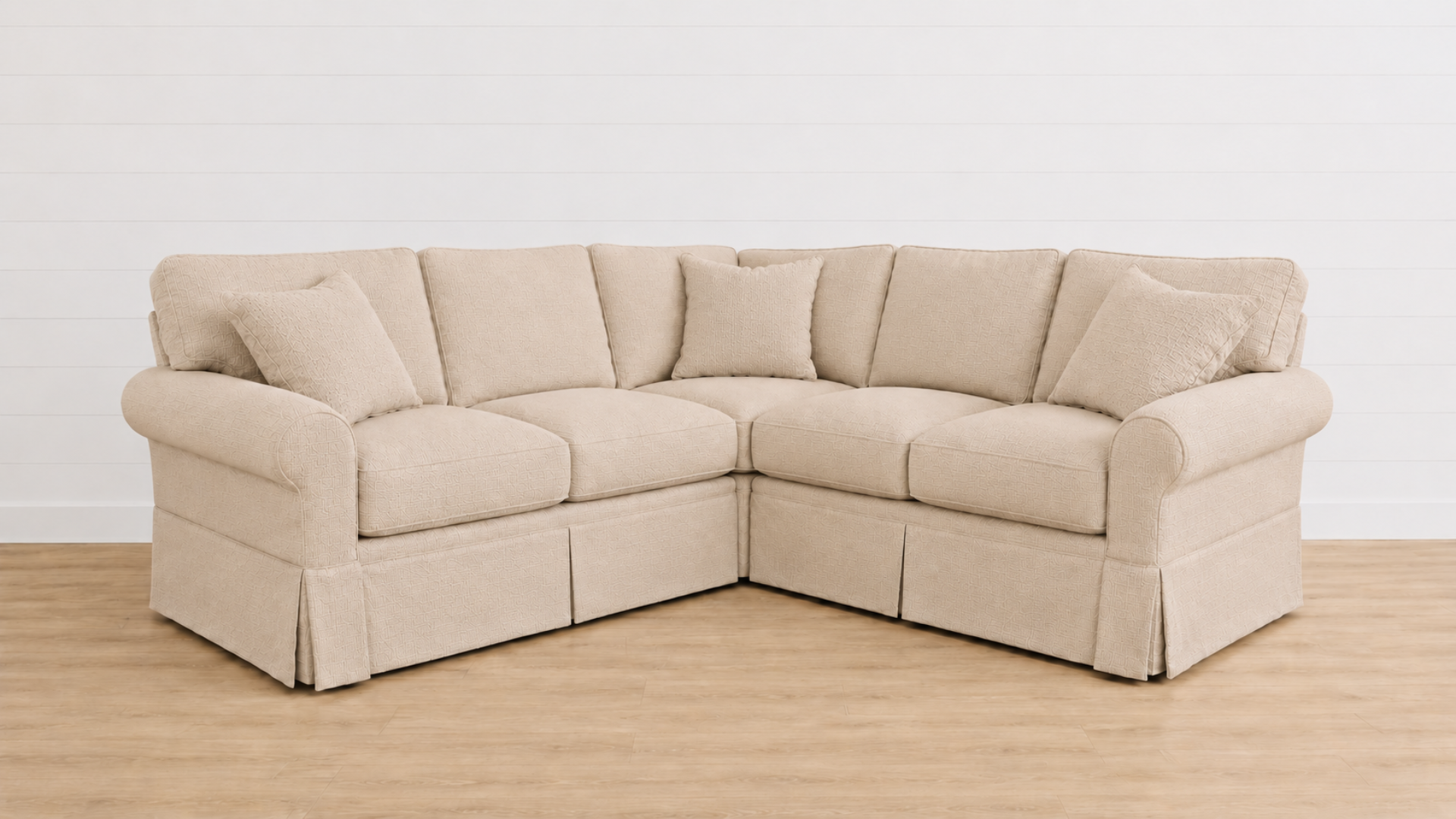
Step 1: Start with how you live, not with color
Almost everyone starts with color. Color is the last decision, not the first.
Before you look at a single swatch, answer four questions honestly — and honestly is the operative word, because the fabric doesn't care what the house rules say.
Who actually uses this room, and how often? A room used daily by four people and a dog has nothing in common with a room used twice a month by adults.
Do you have pets — and what color are they? This matters more than almost anything else, and it's the section people get most wrong. We'll come back to it.
Will you actually wash covers, or do you want to never think about it? There is no wrong answer. But the two answers point at different fabrics.
What's in the room that you can't change? The rug. The wood floor. The stone fireplace. Art you love. Those things are fixed. The sofa cover is the flexible piece.
Those four answers eliminate most of the catalog before you've looked at anything.
Step 2: Choose the fabric against the room, not the other way around
The most common expensive mistake is choosing a sofa and then trying to build a room around it.
Your rug, your wall color, and your natural light are all harder to change than a slipcover — so they get to decide what the fabric has to accomplish.
Go stand in the room and take inventory:
The floor, and specifically its undertone. Warm — red, orange, yellow-leaning? Or cool — grey, ashy, taupe-leaning? This is where most people go wrong. A greige that looked perfect on a screen can turn pink or muddy the instant it sits next to a red-oak floor.
The rug, if you already own it and it's staying. Choose against the rug.
The wall color— and whether it's staying. If you're painting anyway, say so. Paint is far easier to match to fabric than fabric is to match to paint.
The biggest wood tone you can see from the sofa.
Which way the windows face, and how many hours of direct sun actually hit that spot.
On light: in the northern hemisphere, north-facing rooms get cool, steady light all day. South-facing is warmer and much stronger. East is bright and cool in the morning; west goes gold and intense in late afternoon. A fabric that reads as a soft greige in a north-facing room can read distinctly warm in a west-facing room at five o'clock. A north-facing room in February is a different environment from the same room in July.
Take two photos of the empty spot — one in the morning, one around four. You'll use them later.
Then one question that eliminates a huge portion of what's left: is this sofa the quiet piece, or the statement piece?
For most rooms it's the quiet one. The sofa is usually the largest continuous soft surface in the space, and large surfaces are where the eye rests. Keep it quiet and the rug, the art, the pillows, and the view get to be interesting.
The simple version: the loud thing and the quiet thing trade places. Busy patterned rug means quiet sofa. Plain sisal or a solid wool means a patterned or strongly colored sofa is genuinely a possibility. Two loud things in one room fight, and the fight never resolves.
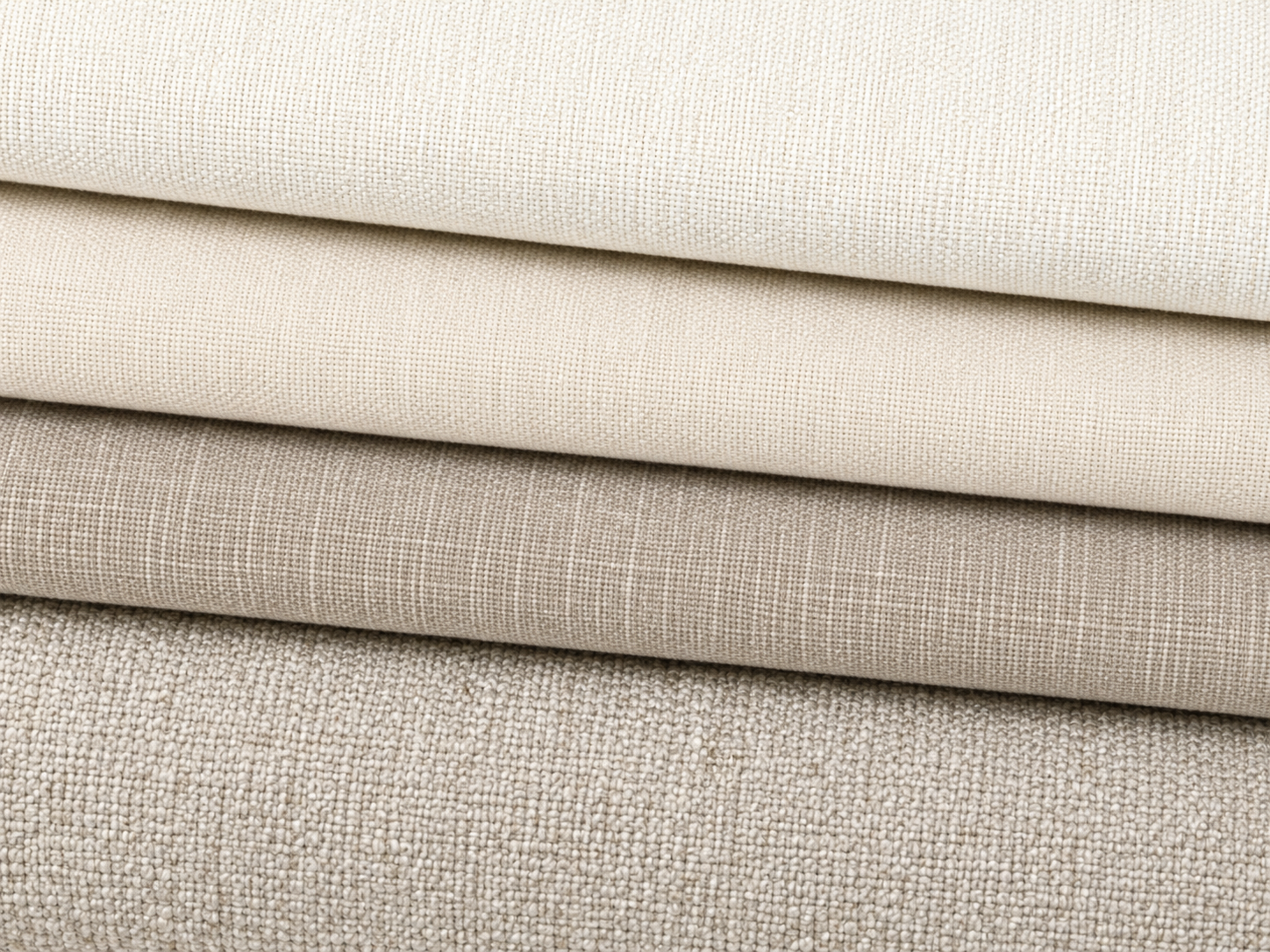
Step 3: Match the fabric to the animal, not to the fear
Here's where most people get it exactly backwards.
People choose dark fabric because it hides stains. But in a house with a light-coated dog, the thing you look at every single day is not a spill. It's hair. And cream-colored hair on charcoal fabric is visible from the doorway.
Golden retriever, yellow lab, husky? Go lighter than instinct suggests. Black lab, or a dark-coated cat? Now darker fabric genuinely earns its place.
And a counterintuitive one worth knowing: white is often the easiest color to live with when the cover comes off, because it's the one fabric you can bleach. A permanent stain on a taupe cover stays taupe with a spot on it forever. On white, it's a wash cycle. Check the care instructions first — bleach is fine on many cotton and linen whites, but it can damage or yellow some fibers and can strip a stain-resistant finish — but where it's allowed, it changes the math on light fabric completely.
Texture matters as much as color with pets. Loose or looped weaves are a poor idea with cats, because claws find the loops. Chenilles, bouclés, and anything with a visible loop or long float give a claw something to hook and pull. Tight flat weaves, canvases, and denims don't offer the same challenge.
Worth knowing when you're comparing spec sheets: abrasion resistance and snag resistance are measured by two different tests. A fabric can score beautifully on durability and still snag badly. Ask about both.
Step 4: Understand what "performance fabric" is actually buying you
Nearly everything in furniture is sold as performance fabric now, and the word is doing a lot of work.
Performance generally means stain resistance — a fiber or treatment that keeps liquid from soaking in immediately. In the right situation it's genuinely useful.
But if your cover comes off and goes in the wash, you may be paying for a solution to a problem you've already solved another way. Performance fabric earns its money in a house with small children where the sofa takes daily hits and nobody wants to pull covers every few weeks. It earns less in a room with moderate adult use and a washable cover.
Buy it for a reason. Not for the label.
The durability numbers, honestly
You'll run into "double rubs" — the Wyzenbeek abrasion test, counting how many back-and-forth cycles a fabric survives before showing wear. Fifteen thousand is the industry's heavy-duty threshold, and most reputable residential fabrics clear it comfortably.
Two caveats, both from the industry's own standards body:
The number is a band, not a point. Repeat tests on the same fabric have varied by sixty percent or more. The standards body explicitly advises against comparing absolute numbers.
There's a ceiling on what it tells you. Results above 100,000 double rubs have not been shown to indicate longer fabric life, and anyone publishing numbers that high is required to disclose it. If a competitor waves 250,000 double rubs at you, that claim is past the range the test itself will stand behind.
Also: the European test (Martindale) and the American one (Wyzenbeek) do not convert to each other. Any chart claiming otherwise was invented by whoever published it.
Use the number to screen out the genuinely unsuitable, then stop. Past the threshold, weave, fiber, cleanability, and whether the cover comes off all matter more.
Cleaning codes
Most fabrics carry one, and it's worth checking before you fall in love:
W— water-based cleaners
S— solvent-based cleaners only
WS— either
X— vacuum or brush only, no liquid cleaning at all
With slipcovers, ask the more important question underneath it: can this specific fabric be washed, and how? Machine-washable, dry clean only, and professionally cleaned are three very different lives.
And about fading
Saturated colors don't necessarily fade faster than neutrals. Fading shows more on them — a deep navy losing ten percent of its color is obvious, and an oatmeal losing the same amount is nearly invisible.
What actually predicts fade resistance is fiber and dye method. If the sofa sits in hard direct sun, ask about lightfastness, and ask whether the fiber is solution-dyed — meaning the color is built into the fiber itself rather than applied to the surface afterward. That's the specification that matters, not the shade.
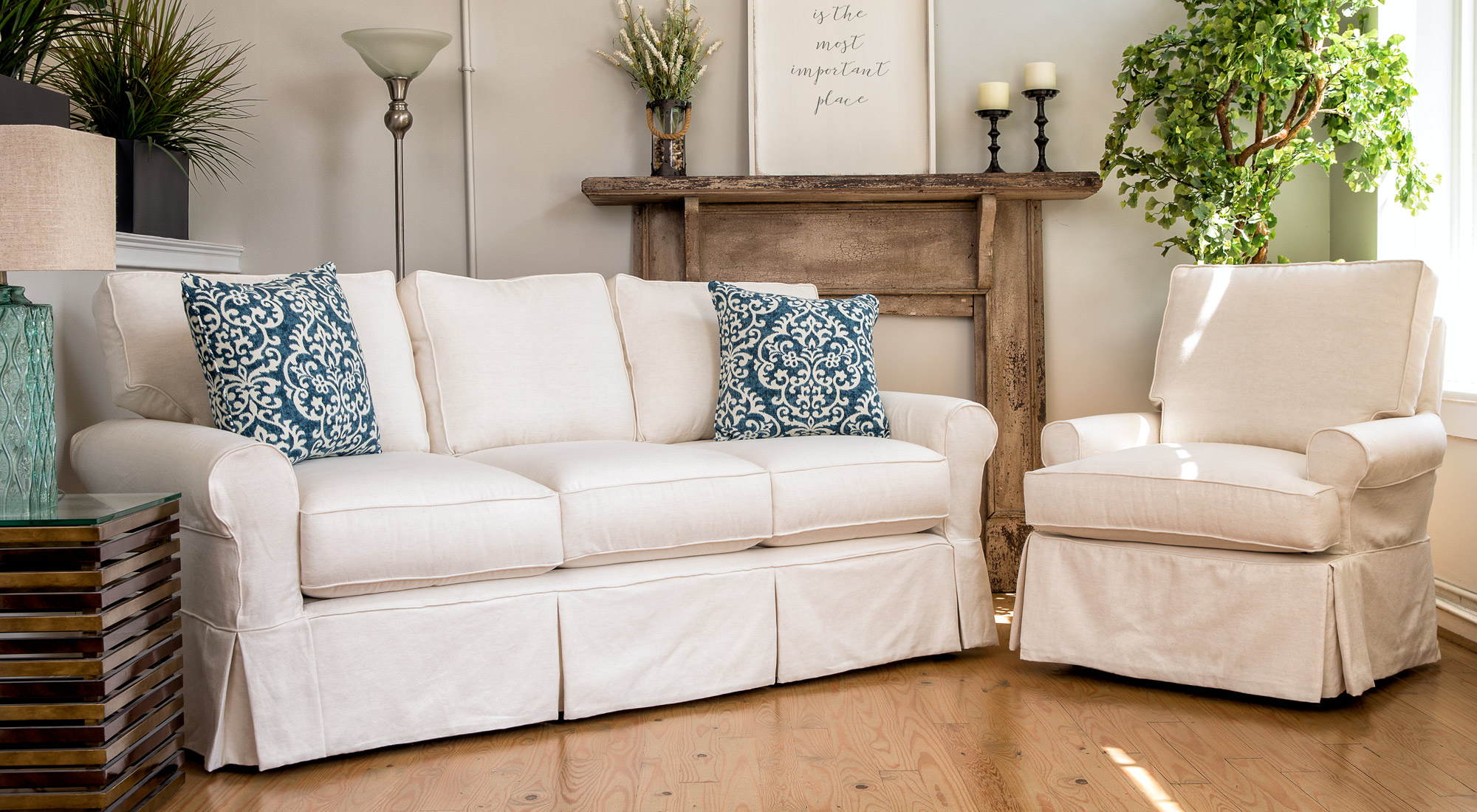
Step 5: Pick a lane before you order swatches
We'll send up to nine free swatches. Most people are better served ordering four or five.
Nine gives you a comparison problem instead of a decision. Past a certain number you stop evaluating and start circling, and the whole thing stalls.
So pick a lane first: warm neutral, cool neutral, or color. Stay in it.
Ordering three warm creams, two cool greys, and four blues guarantees a second round — because you're not comparing fabrics anymore, you're still deciding what kind of room you want. Those are different questions and swatches can only answer one of them.
Here's why this matters more than it sounds: swatches take about ten business days to arrive. They're cut and shipped from our manufacturer. A second round isn't an inconvenience, it's three more weeks. Getting the lane right before you order is worth more than any other ten minutes you'll spend on this.
If you don't know which lane you're in, that's the conversation to have with us before the swatches ship, not after. Tell us about the room and we'll suggest which ones to request. That sequence is usually faster, and it costs nothing.
Step 6: Get the real fabric into your actual room
Screens lie about fabric. Every one of them. Monitor calibration changes color, photography lighting changes texture, and a fabric that looks warm on a white studio background can read grey against your floors.
Screens are for narrowing. Swatches are for deciding. When they arrive:
Look at them only in the room. Not in the kitchen, not at the office, not in the car on the way home from the mailbox.
Look at three different times of day— morning, late afternoon, and at night with your lamps on. Artificial light shifts undertone hard. If you've only seen a fabric in daylight, you haven't seen it in the light you'll actually use the room in most.
Lay them flat, at roughly seat height— not held up in the air. Fabric reflects light differently by angle, and a swatch held toward a window can read a full step lighter than the same fabric lying flat on a seat. Flat on the floor next to your rug is the real relationship.
Drape one over the arm of your current sofa. Scale and texture read completely differently at furniture size than at swatch size, and a color spread across eighty inches reads more saturated than the same color in a four-inch square. If a swatch is right at the edge of "too much," the sofa will be over that edge.
Abuse them. They're free. Scratch one with a fingernail the way a dog would. Rub it hard with your palm. Put a drop of water on one corner and a drop of olive oil on another and watch for an hour. Hold it to the light to see how open the weave is. You cannot do any of this in a showroom and it will teach you more than any spec sheet.
Photograph the swatch in the room and look at the photo. Flattening it strips the texture out and shows you how the color actually behaves in the space.
Then live with them for several days. Tape them up where the sofa goes and go about your week.
This is the part that ends the paralysis, and it works for a simple reason: The one you stop noticing is usually the right one. The one you keep walking over to check on is telling you something is slightly off. The one you liked instantly is not always the one you still like on Thursday.
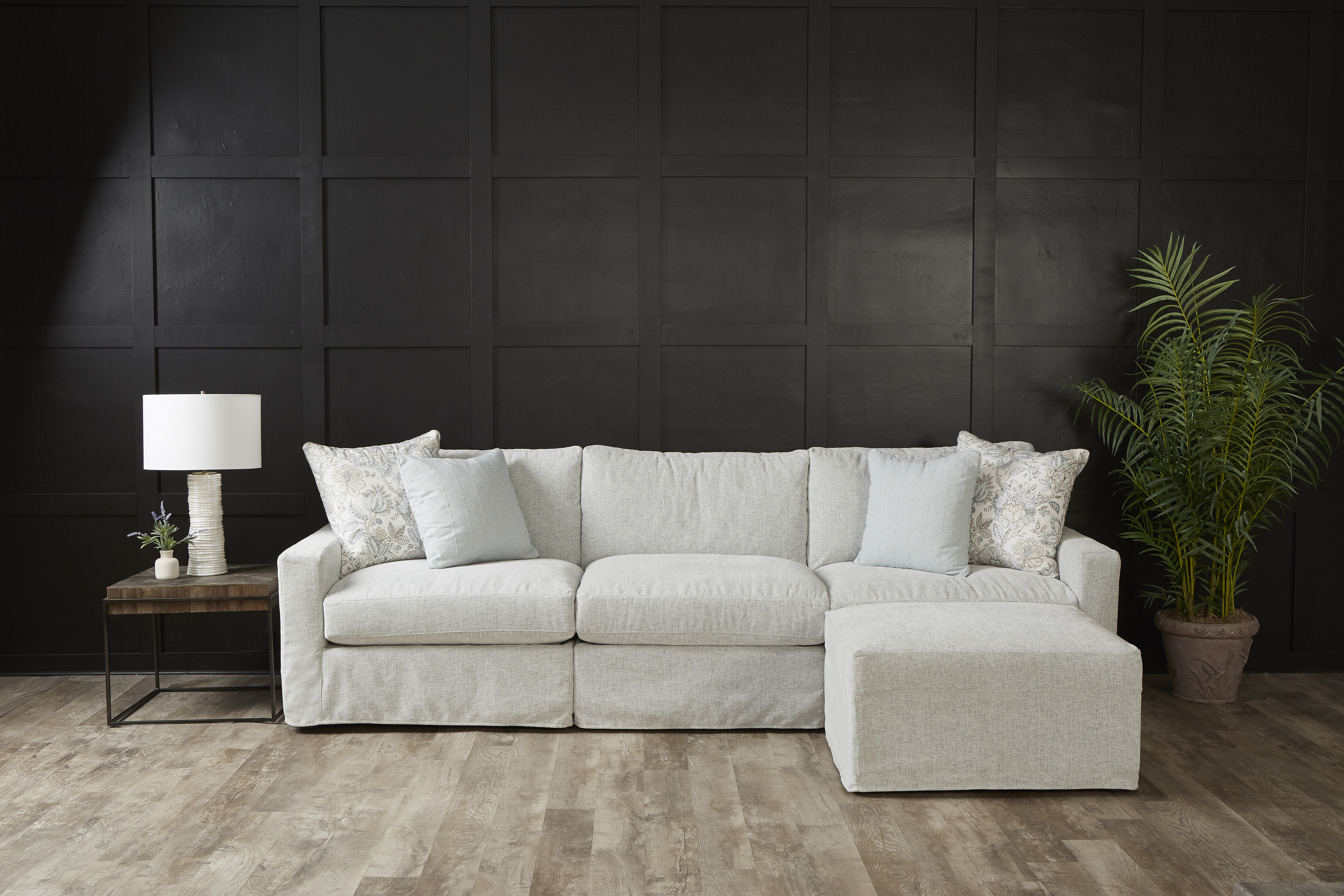
Step 7: If none of them are right, that's useful
Custom shouldn't mean confusing
This is the point where a lot of people quietly give up. They shouldn't.
Fabric selection is a process of elimination. Learning that all four of your creams read too yellow in your room is not a failed round — it's the most useful thing you've learned yet. It tells us exactly which direction to go next.
Don't start over alone. Tell us what was wrong — too yellow, too grey, too smooth, too busy — and the next set gets picked based on what you just learned about your own room.
That's a normal part of the process, not a problem. Most people who order twice, buy.
Step 8: Now do the pillows
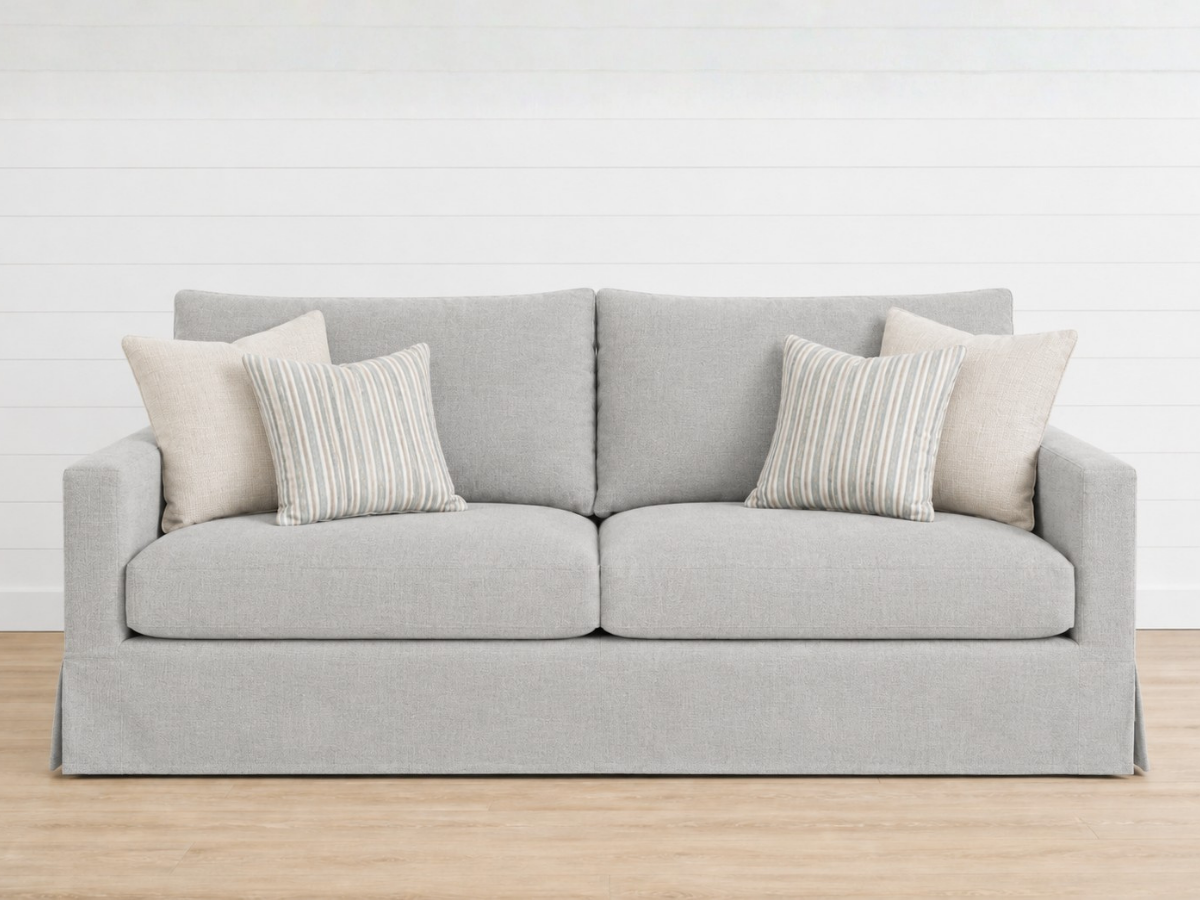
Pillows are a separate decision, made second. Never first. Choose pillow fabric before body fabric and you've made the small decision the boss of the big one.
Contrast in one dimension, not three. A pillow can differ from the sofa in value, or texture, or pattern. Pick one. Darker and shinier and patterned stops reading as a layer and starts reading as a clash.
Vary the scale. A good group is usually one larger-scale pattern, one small geometric or stripe, and one solid texture. Odd numbers, and never two same-scale patterns side by side.
Pull a color that's already in the room— from the rug, from art, from a book spine, from the view out the window. Colors already present feel intentional. Colors introduced only in a pillow feel like a pillow.
Same-fabric pillows are a real choice, not a default. Body fabric on the pillows reads quiet, tailored, and architectural, and it lets the shape of the piece do the talking. It's underrated and it's the easiest thing to layer over later.
The strategic point: pillows are where trend risk belongs. They're the cheapest and fastest layer to change. If there's a color you love right now but aren't sure about in five years, put it in the pillows — not in eighty inches of body fabric.
Step 9: Welting — smallest decision, biggest tell
Welting is the corded seam tracing the edges of the piece. Most people never consciously notice it. Everyone registers its effect.
Self-welt— same fabric as the body. Quiet, tailored, timeless, and it goes with anything you do to the room later. This is the safe answer and most of the time it's genuinely the right one.
Contrast welt— a different fabric, drawing a line along the silhouette. It sharpens the shape and makes a simple sofa look distinctly custom. Used well it's the detail that makes a room look designed. Used carelessly it dates quickly and commits you to a color relationship every future purchase has to honor.
Tonal welt— the same hue two or three shades deeper. This is the move that makes people say a room looks expensive without being able to say why. It defines the shape without committing you to a second color.
Two practical rules. If the body fabric is patterned, use self-welt— a pattern already has edges and a contrast cord competes with them. If you plan to change pillows seasonally, keep the welt neutral, or it will quietly veto your pillow choices three years from now.
And one question worth asking before you order a contrast welt on a washable cover: how do the two fabrics behave laundered together? Different fibers and dyes can shrink at different rates or move color, and a cord that puckers or bleeds along a seam is very visible on a tailored piece. Ask. There's usually a straightforward answer.
Step 10: The math nobody runs
Take the price of what you're considering. Divide by the number of years you honestly expect to keep it. Now do the same for the cheaper option.
A well-built frame that lasts twenty years, with a fresh cover in year seven and another in year fifteen, has a very different annual cost from replacing a disposable sofa every four or five years — and the disposable route also means four or five delivery days, four or five disposal problems, and four or five weekends lost to shopping.
The reason this belongs in a fabric article is that it tells you where to spend your attention. Frame, suspension, and cushion construction determine whether that twenty-year number is real. Interrogate those hard — eight-way hand-tied versus sinuous spring, kiln-dried hardwood versus engineered frame material, what's actually inside the cushion.
The fabric is the layer you get to redo. That's not permission to be careless about it. It's permission not to be frozen by it.
Five ways people get this wrong
Choosing fabric before deciding the room. The fabric ends up beautiful and wrong.
Deciding on a screen. Every year people order without swatches and are surprised. Every year.
Choosing dark to hide stains, in a house with a light-coated dog.
Letting the pillow drive the sofa. The tail wagging an eighty-inch dog.
Treating the fabric as permanent. On slipcovered furniture it isn't, and believing otherwise is what turns a one-week decision into a three-month stall.
After you order: four things to write down
The exact fabric name, number, and/or colorway, somewhere you'll actually find it. A note on your phone, an email to yourself, taped inside a drawer. "The beige one" is not a record.
A leftover swatch. Tape it under the frame or file it with the paperwork. It's how you match paint, order a coordinating chair, or verify a reorder years later.
The cleaning code and the care instructions— and if the cover is washable, the exact washing and drying instructions. Most slipcover disasters are dryer disasters.
Whether you want a second cover. If you already know you want one — a lighter one for summer, or a spare for the kid years — ask about ordering it in the same production run. Fabric is made in dye lots, and two runs of the same fabric ordered years apart can differ slightly. Usually subtle, usually fine. But if you want them to match exactly, the time to say so is now.
Custom shouldn't mean confusing
Custom gives you more choices. It shouldn't mean making all of them by yourself.
Tell us about the room, the people in it, the animals in it, and the things you can't change. We'll suggest a starting set and you go from there.
You're not choosing the fabric you'll live with forever. You're choosing the fabric for the next chapter of the room — and a well-built piece will still be there for the chapter after that, wearing something else.
That's a much easier decision than the one you thought you were making.
Order Free Fabric Swatches →
Common questions
How many swatches should I order? Up to five are free, but four or five within a single direction usually produces a faster decision than nine spread across three directions.
How long do swatches take to arrive? About ten business days. They're cut and shipped from our manufacturer — which is why picking a lane before you order matters so much.
Can you help me choose before I order them? Yes, and it's often the better sequence. Tell us about the room and we'll suggest which ones to request.
What if I don't like any of them? Tell us what was wrong and we'll send another set. It's a normal part of the process, not a problem.
Can I order a different slipcover later? Yes. That's the design of the whole thing. The frame is built to outlast several covers.
Should I choose the body fabric, pillows, and welt at the same time? No. Body fabric first, pillows second, welt last. Deciding them together is what makes the choice feel impossible.
